Bots or people? How to tell an artificially amplified post from one with real reactions
by Claudiu Hulea · IT Management Consultant
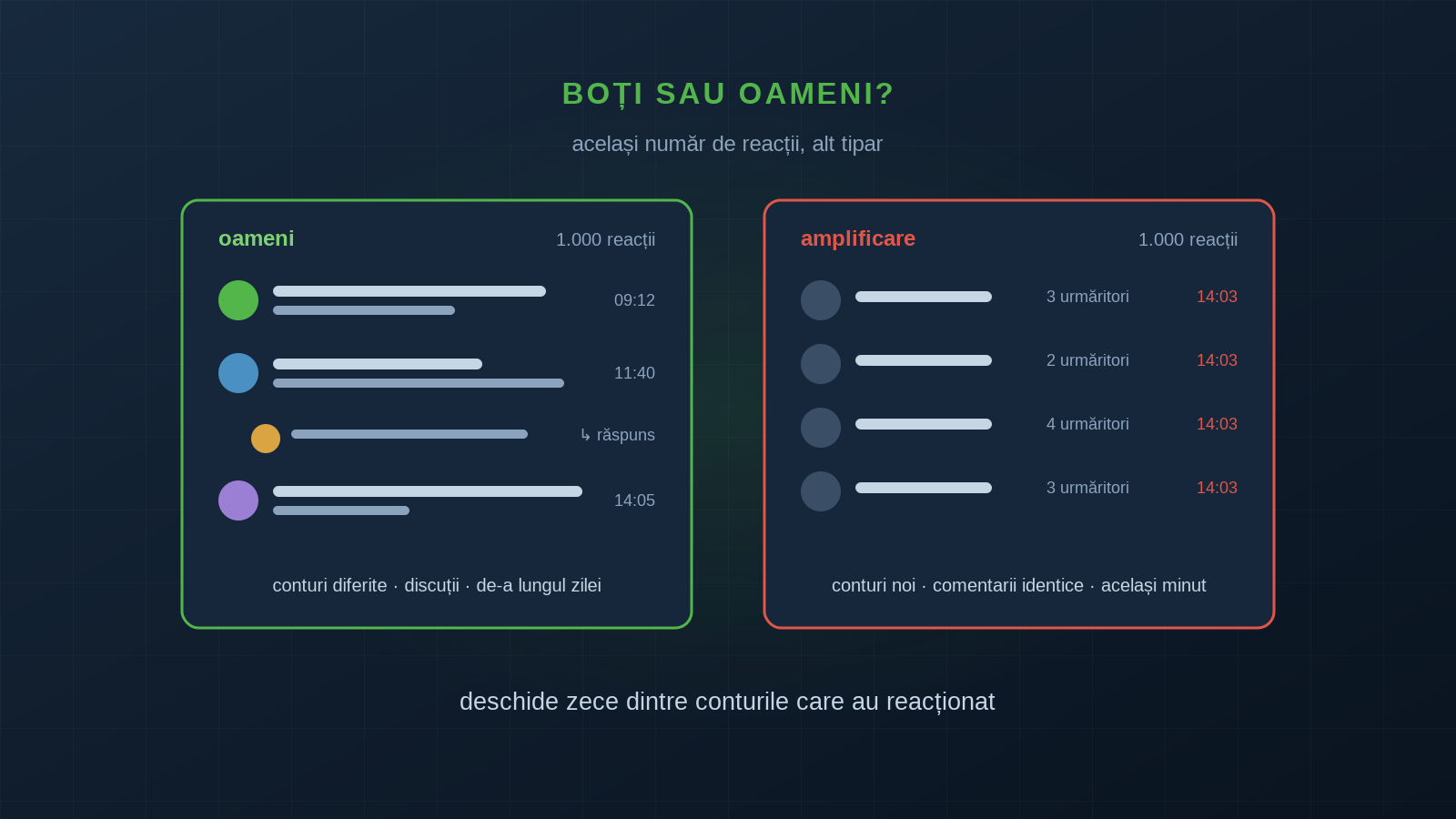
The number of likes and comments under a post does not say who reacted. The pattern of the reactions does. A thousand reactions from different people, commenting on different things, over a day, look different from a thousand reactions from new accounts with almost no followers, writing the same thing in the same minute. The difference shows, if you know where to look.
Why it matters: the lesson of 2024
On 6 December 2024, Romania’s Constitutional Court annulled the entire electoral process for the election of the President of Romania. Two days earlier, the President had approved the declassification of the briefings the intelligence services presented at the 28 November meeting of the Supreme Council of National Defence. On 17 December, the European Commission opened formal proceedings against TikTok under the Digital Services Act. Among other things, the proceedings concern the risks linked to coordinated inauthentic manipulation of the systems that recommend content. Opening the proceedings does not prejudge their outcome.
TikTok’s reports from that period show how much “popularity” can be manufactured:
- networks of accounts that hid their origin, removed one after another, promoting different candidates and parties, from different camps;
- the largest of them, operated, according to TikTok, from outside the country: the platform first removed 4,453 accounts, then another 22,764 it considered part of the same network. TikTok says these inauthentic accounts, with roughly three followers each, used fictitious personas to post comments rather than videos, and that a fake engagement vendor had been paid for the comments. Who commissioned it is not known;
- in its election reporting, the platform says that from September to early December 2024 it prevented nearly 45 million fake likes and removed more than 7 million, plus more than 115,000 fake accounts.
The lesson is broader than elections. The same mechanisms are bought for products, for reviews, for investment scams, to hit a brand. And the algorithms that decide what everyone sees respond to numbers, not to who is behind them.
“Bots” does not only mean software
When we say “bots”, we think of accounts run automatically. In practice, artificial amplification takes several forms:
- automated accounts that like, follow and share with no person behind them;
- fake accounts operated by hand, usually in large numbers, by a vendor paid for engagement;
- real accounts, bought or compromised, that have a history and look credible;
- groups that like each other’s posts by agreement, to game the algorithm.
Specialists call the phenomenon “coordinated inauthentic behaviour”: networks of accounts that work together and hide who runs them. The key word is “coordinated”. An isolated fake account matters little. A network acting in unison changes what ends up looking popular.
Signals in the accounts that react
The first step is simple: open some of the accounts that liked or commented. Not one, but ten.
- very new accounts or, on the contrary, old accounts, inactive for years, that suddenly wake up, all at once;
- very few followers and very few posts of their own;
- generic profiles: no photo or a stock photo, names that resemble each other, empty bios;
- a history that is all campaign: the account does nothing other than support the same topic or the same person.
Signals in the content
- identical or near-identical comments, with the same words, the same emoji or the same hashtags;
- comments unrelated to the post, generic (“Great!”, “So true!”) or ignoring entirely what it says;
- mismatched reactions, for example laughing reactions under tragic news;
- no discussion: many reactions, but nobody replies to anybody and nobody disagrees with anybody.
Signals in timing
- a wave of reactions in a very short interval, then almost nothing;
- many accounts switching on together around an event;
- a post that outperforms the account’s average tenfold or more, for no visible reason, for example without having been picked up by someone well known.
Real interest rises and falls more smoothly. People see a post at different times, from different places, through different paths.
Signals in the numbers
Sometimes the numbers simply do not add up:
- more likes than views, or more shares than likes;
- thousands of reactions and almost no substantive comment;
- many followers, but posts that get almost nothing, a sign that the followers are not people who read.
The right comparison is with the account itself: what its other posts usually look like.
Network signals
If you look at several accounts at once, the links between them can show:
- accounts that interact mostly with each other;
- accounts that follow exactly the same pages;
- the same message, appearing at the same time on several platforms or in several groups.
What real reactions look like
By contrast, reactions from real people have a few traits that are hard to imitate at scale:
- accounts that differ from each other, with a history, with friends and interests unrelated to the topic;
- comments that refer to details in the post: questions, additions, disagreements;
- discussions: people reply to each other;
- gradual growth, over hours or days, as the post is seen and shared.
Beware of hasty accusations
No signal on its own is proof. Real people create new accounts, real communities rally openly (fans, supporters, professional peers), and viral content spreads quickly by itself. The difference between a community and a hidden campaign usually lies in two things: whether the participants say openly who they are and whether their accounts are authentic.
So look at the pattern, not at one account. And if you suspect a campaign, report the accounts to the platform instead of publicly accusing specific people. You can be wrong, and you can help the very message you want to stop by giving it even more visibility.
What you can do, concretely
- Do not take popularity as an argument. A post having many reactions does not make it true.
- Check a sample of accounts before sharing something that seems to have “blown up”.
- Look for the source: who said it first and whether a credible source confirms it.
- Report accounts that look fake or that pose as someone else.
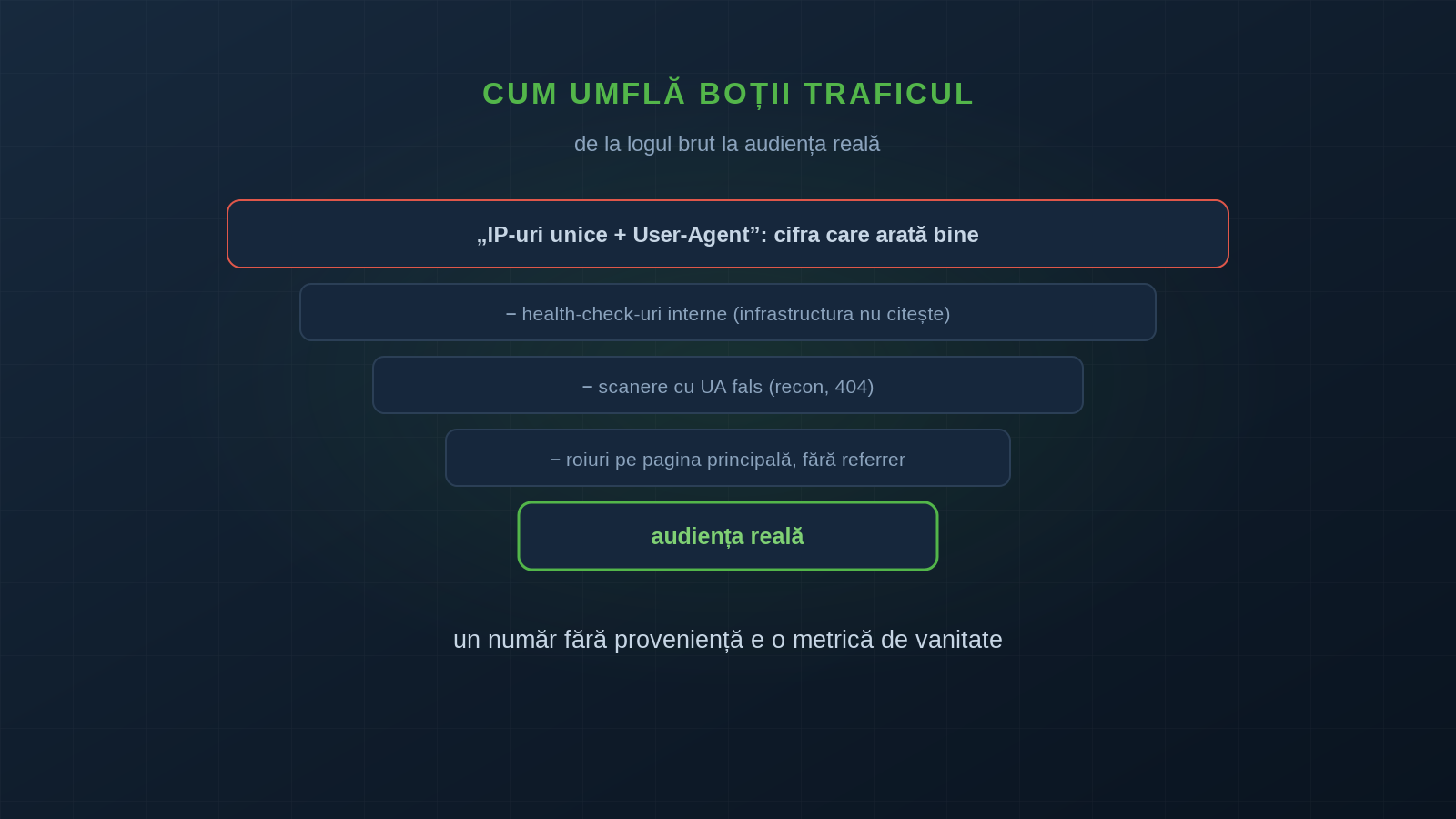
- As a company, do not buy engagement. You make decisions on meaningless numbers, and the reputational risk outweighs the gain. We wrote about the same trap in traffic numbers inflated by bots.
- As a company, watch what is said about you: accounts posing as the company or as people in its leadership, sudden waves of reviews, campaigns that start from new accounts.
What we take away
Popularity can be bought, but it is bought badly: new accounts, empty profiles, identical comments, sudden waves, numbers that do not add up. None of these signs proves anything on its own, but together they say a lot. Before you believe or share a post just because it seems everyone agrees, open ten of the accounts that reacted. It takes two minutes.
Do you want the people in your company to recognise online manipulation, from phishing emails to accounts posing as colleagues or as the company? Contact us.
Sources
- Romanian Constitutional Court: press release of 6 December 2024
- Romanian Presidential Administration: declassification of the briefings presented at the Supreme Council of National Defence, 4 December 2024
- European Commission: formal proceedings against TikTok on election risks, 17 December 2024
- TikTok: protecting the integrity of the platform during the Romanian elections
- EU DisinfoLab: CIB detection tree, impact assessment
- IFTAS: coordinated inauthentic behaviour, a guide for moderators
Frequently asked questions
How can I quickly tell whether the reactions to a post are real?
Open ten of the accounts that reacted or commented. If most are new, without a real photo, with a handful of followers and nothing else posted, and the comments resemble each other, you have reason for doubt. If they are different people, with a history, saying different things, the reactions are most likely real.
Is a single sign, for example a new account, proof that it is a bot?
No. Real people create new accounts too, and real communities can rally around a topic. An isolated sign proves nothing. What matters is the pattern: many accounts that look alike and behave the same way, at the same time.
What do I do if I suspect a fake-account campaign?
Do not share the post just because it looks popular. Report the suspicious accounts through the platform. Do not publicly accuse specific people based on a suspicion, because you can be wrong and you can amplify the very message you are fighting.
Does this concern me as a company too?
Yes. The same techniques are used for fake reviews, to inflate or attack a brand, and for accounts that pose as a company or a well-known person. And a company that buys engagement ends up making decisions on numbers that mean nothing.