Microsoft Defender bypassed again (ShieldBreak): PoC grants SYSTEM, but it needs local access first
by Claudiu Hulea · IT Management Consultant
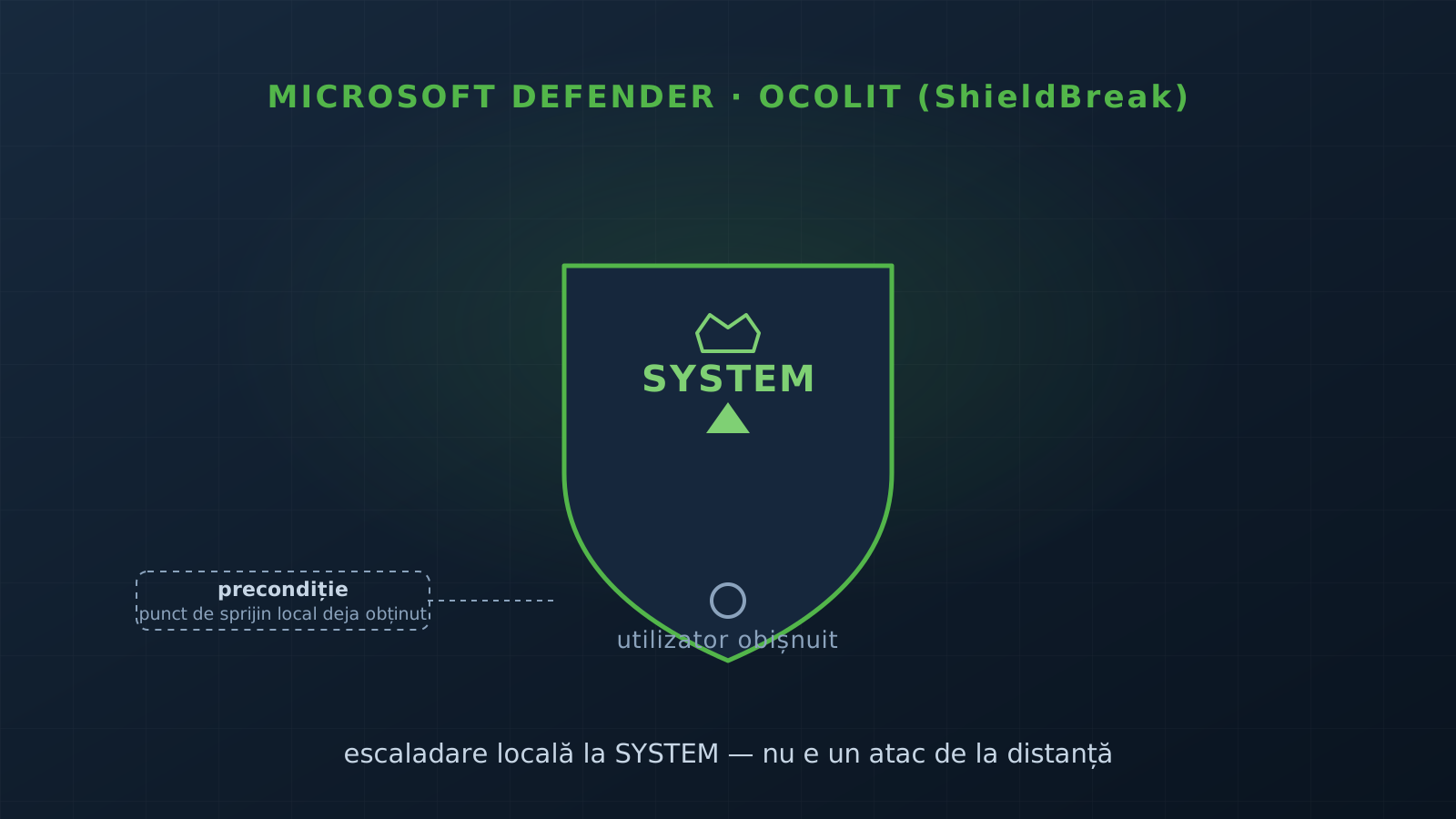
A researcher has published ShieldBreak, a PoC that bypasses Microsoft’s patch for a privilege-escalation flaw in Microsoft Defender and raises a process to SYSTEM. The headlines sound apocalyptic; the detail that matters, buried underneath them: it is not a remote attack. It is a local escalation that assumes the attacker is already on the machine. Below: what it really is, and what to do in a managed fleet.
In brief
- ShieldBreak — a PoC demonstrating a bypass of Microsoft’s fix for RoguePlanet (CVE-2026-50656), a privilege-escalation flaw in Microsoft Defender. ShieldBreak has no CVE of its own: it is the bypass of a fix, not a newly registered vulnerability.
- Effect: raises a process from an ordinary user to SYSTEM. Requires Defender enabled.
- Affected: Microsoft Defender on Windows 10, Windows 11 (25H2) and Windows Server 2025 (per BleepingComputer and The Hacker News).
- NOT remote: it is a local escalation — the attacker already has a foothold on the machine and only raises privileges.
- Status: no patch as of 12 August 2026; the PoC bypasses even the August 2026 Patch Tuesday fix. No confirmed exploitation in the wild.
- Attribution: researcher “Nightmare Eclipse” (a.k.a. Chaotic Eclipse) — the same handle behind the BitLocker YellowKey PoC. It is part of a wave of Defender disclosures (RoguePlanet, RedSun, BlueHammer).
- Microsoft: contacted by the press, no statement at the time of publication.
What ShieldBreak actually is
In July 2026, Microsoft patched RoguePlanet (CVE-2026-50656) — a weakness that allowed escalation to SYSTEM through Defender. ShieldBreak is the researcher’s claim that that fix is incomplete: the PoC replays the attack on an up-to-date system and, per the report, succeeds. In other words, it is not a new breach but proof that the old hole never closed — a patch bypass.
A single PoC, from a single researcher, is treated with due caution. We note it because two serious security outlets picked it up (BleepingComputer, The Hacker News) and because it fits an already visible pattern of Defender escalations. We do not amplify it beyond what it is: a demonstration, not an attack in progress.
It is not a remote attack. And that changes everything
This is where most headlines part ways with the rest of reality. ShieldBreak is a local privilege escalation (LPE). To use it, an attacker must already be running code on your machine, as an ordinary user. Only from there does it climb to SYSTEM.
In risk terms: an LPE is not the front door, it is the elevator from the ground floor to the top — after someone is already in through a window. It matters, but in the second half of the attack chain: a successful phish, a macro, a compromised app gives them the ground floor; an LPE like ShieldBreak turns that trivial foothold into full control of the machine. That is why the right response is not panic (“Defender is hacking me”) but the sober question: how easily does someone reach the ground floor, and what do they see there?
When the detector becomes the attack surface
The irony worth keeping: the exploit requires Defender enabled. That is, the very product meant to protect you becomes the escalation step. It is not the first time and not specific to Microsoft — any security agent runs with high privileges, everywhere, and is therefore a high-value target, not an untouchable zone.
The practical takeaway is not “remove Defender” (that would be worse). It is that no single control is infallible, not even the security one. A healthy endpoint does not lean on one layer that “does everything,” but on several layers that cover one another when one gives way.
A patch is not always a fix
The most transferable lesson in ShieldBreak is not about Defender. It is about patching hygiene. RoguePlanet was “fixed” in July; the PoC says the fix is bypassable, even after August’s Patch Tuesday. Patch bypass is a common phenomenon: a rushed or incomplete fix closes the symptom, not the cause.
For a managed fleet, that means a simple reflex: apply patches fast, but do not assume “patched” = “closed.” Verify, monitor, and treat a “resolved” CVE as resolved only once you have seen it at home, not just in a changelog.
Our recommendations
ShieldBreak does not call for an emergency response (it is not remote, not exploited). It does call for exactly the hygiene that matters anyway, with or without it:
- Defense-in-depth on the endpoint. Do not let Defender (or any single AV/EDR) be the only layer. EDR + behavioural monitoring + application control that cover one another. Part of the security audit and endpoint hardening.
- Cut off the ground floor, not just the elevator. Because an LPE needs a foothold, the biggest leverage is making the foothold hard: phishing resistance, patching on the entry points, no local admin on workstations, least privilege. An attacker who never reaches the ground floor has nothing to escalate.
- Patch fast — but verify. Apply Microsoft’s fix as soon as it ships. And because RoguePlanet has already been “fixed” once, confirm at home that the problem really closed, not just in the release notes.
- Detect on anomalous behaviour. Monitor unusual activity around security processes and privilege manipulation — the signals of escalation, not the signature of one specific exploit.
Want to know how easily someone reaches “the ground floor” in your fleet, and how deep the layers below it go? Get in touch and we start with an audit.
Frequently asked questions
What is ShieldBreak?
A PoC (proof-of-concept) demonstrating a bypass of Microsoft's patch for RoguePlanet (CVE-2026-50656), a privilege-escalation flaw in Microsoft Defender. ShieldBreak has no CVE of its own — it is a bypass of the fix for an existing CVE. According to BleepingComputer and The Hacker News, it raises a process from an ordinary user to SYSTEM on systems with Defender enabled.
Is it a remote attack? Am I hacked just for running Defender?
No. It is a LOCAL privilege escalation: the attacker must already run code on the machine, as an unprivileged user, and only climbs from there to SYSTEM. It is not "anyone breaks in over the internet." It is a link in the attack chain after the initial compromise, not the entry point.
Is there a patch?
Not at the time of disclosure (12 August 2026). The researcher claims Microsoft did not fix RoguePlanet properly and that the PoC bypasses even the August 2026 Patch Tuesday fix. Microsoft was contacted by the press and, at publication, had not issued a statement. There is no evidence of exploitation in the wild — for now it is a PoC disclosure.
What do I do until the fix lands?
Treat the endpoint with defense-in-depth: do not rely on Defender as the only control, reduce entry points and local privileges (no local admin on workstations), monitor for anomalous behaviour, and apply Microsoft's patch as soon as it ships — but verify, a patch is not automatically a fix (RoguePlanet was "patched" and is still bypassed).