KillSec dismantled: lessons from ~500 victims and an international takedown
by Claudiu Hulea · IT Management Consultant
On 1 October 2026, German authorities announced a blow to the KillSec ransomware group. In an international operation coordinated by Europol and Eurojust, police searched eight properties across Spain, Greece, Romania and the UK, arrested three people, took control of five servers and the group’s leak site, and secured at least 110 TB of data.
The press reported that the alleged administrator of the operation is a 16-year-old, a Romanian national, detained in Alicante, Spain. Separately, a Dutch national was indicted in the United States for a role tied to KillSec. The administrator’s age drew public attention, but for a company that has to defend itself the useful lesson is not who ran the group, it is how it worked.
How KillSec claimed nearly 500 victims
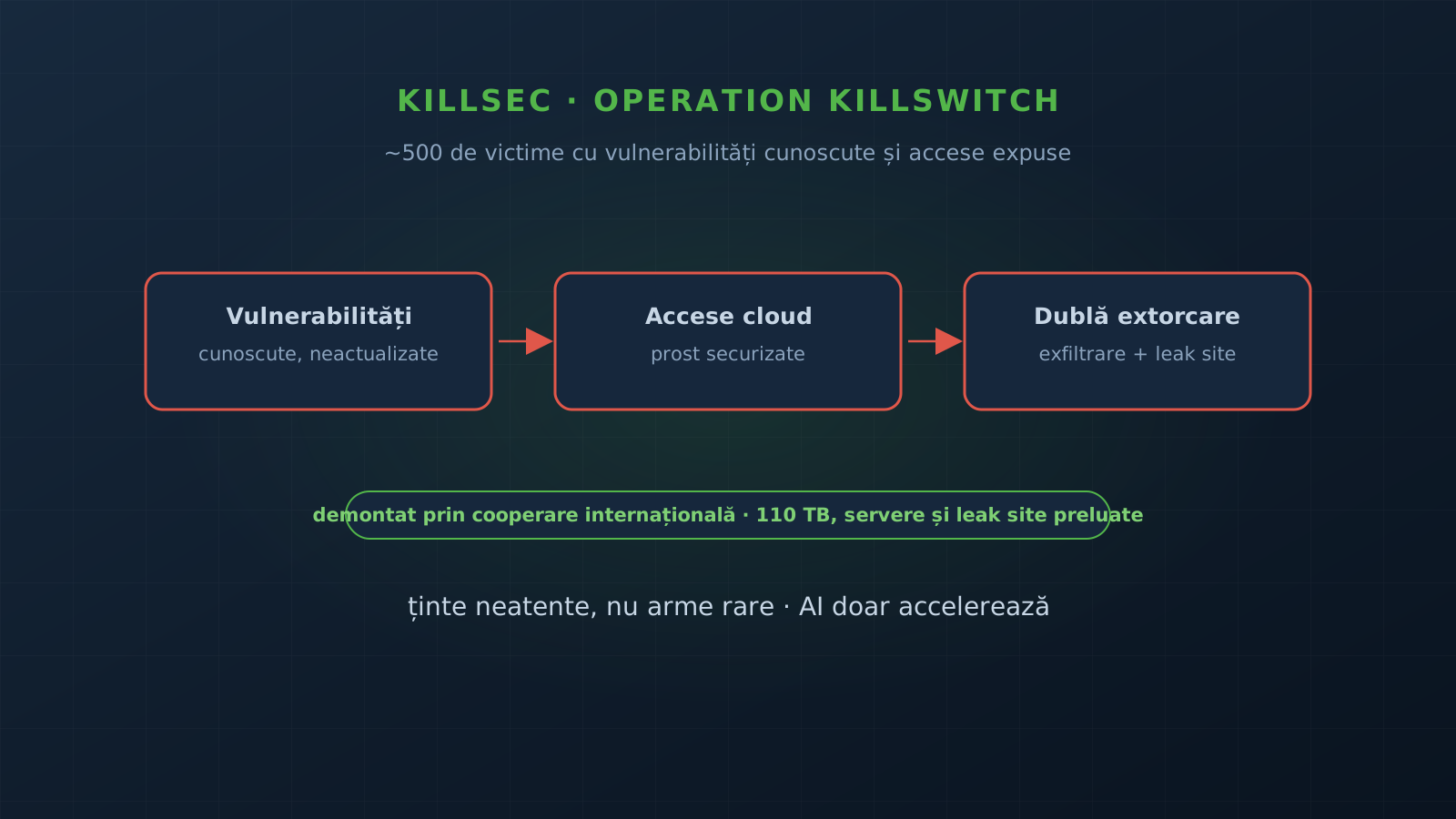
KillSec surfaced in 2024 and became known for opportunistic attacks. It did not bet on rare vulnerabilities, but on the two most common doors: unpatched systems and applications with already-known, vendor-fixed flaws, and poorly secured access, especially in cloud environments. Once inside, it stole the data and threatened to publish it on the leak site unless the victim paid, that is, double extortion.
Investigators cite roughly 1,000 suspected attacks, about 500 confirmed successful, over nearly two years, with at least 70 targeting government organizations. A security firm tracking the group since 2024 counted close to 300 victims on the leak site alone, noting that such lists do not reflect the real number of victims, some never become public.
The uncomfortable part for any defender: none of this requires a genius adversary. It only requires a target that delayed a patch or left an access open.
AI, the accelerator in the background
Investigators found evidence that the group used AI to build and maintain its infrastructure and to identify potential victims. How we frame this matters: AI did not invent a new type of attack. It automated the repetitive work behind a campaign (scanning, triage, maintenance) that used to take time and people.
The practical effect is that the barrier to entry drops and the pace rises. A small group, even one led by someone without long experience, can operate at a scale that a few years ago required a team. For defense, the takeaway is not panic but consistency: if attackers automate the hunt for easy targets, the only countermeasure is not to be an easy target.
What to take away for defense
KillSec’s methods are a summary of the hygiene we keep repeating, because it works:
- Timely patching, prioritized by exposure. The exploited vulnerabilities were known and fixed. The gap between a patch being available and applied is the window opportunistic groups use.
- Close unnecessary access, especially in the cloud. Every access point published on the internet is a possible path. Inventory what is exposed and remove what should not be there.
- Strong authentication and segmentation. A compromised access must not mean access to everything. Separate, limit, monitor.
- Tested, offline backups. Double extortion bets on your inability to restore on your own. A backup you have tested changes the negotiation.
- Send logs off the appliance. If an attacker scrubs your local traces, reconstruction depends on what you already shipped to a SIEM.
Nothing on this list is spectacular. That is exactly why it is effective: it stops the very class of attack KillSec relied on.
The good part: how it was dismantled
Beyond the story about the administrator, the case is also an example of cooperation that works. Authorities from six countries worked together, coordinated by Europol and Eurojust, and technical support came from security firms, among them a Romanian one, Bitdefender, which had tracked the group since 2024 and helped map the infrastructure and monitor it for more than a year.
It is worth saying plainly, because it gets lost in the headlines: in the same case, a Romanian national appears as the alleged administrator, and a Romanian company spent a year on the investigation and helped take the group apart. Cybersecurity has no nationality, on either side.
What we take away
A group that claimed hundreds of victims needed no rare weapons, only inattentive targets. “Operation KillSwitch” removed the infrastructure and some of the people behind it, but it does not change the basic arithmetic of defense: patch on time, close access, test backups, ship logs off the appliance. AI accelerates the attack, but it also accelerates the hygiene that stops it, if you choose to apply it.
Want to know how exposed your infrastructure is to exactly the kind of opportunistic attack KillSec used? Contact us and we start from an exposure assessment.
Sources
Frequently asked questions
What is KillSec?
A ransomware group that surfaced in 2024, known for opportunistic attacks: it exploits known vulnerabilities and poorly secured access, especially in cloud environments, exfiltrates data, then threatens to publish it on a leak site unless the victim pays. Investigators estimate ~1,000 suspected attacks, about 500 of them confirmed successful, over roughly two years.
What was "Operation KillSwitch"?
An international investigation led by German police and coordinated by Europol and Eurojust, with authorities from Germany, the US, the UK, Spain, Romania and Greece taking part. It led to three arrests, searches of eight properties across four countries, the seizure of five servers and the leak site, and the securing of at least 110 TB of data. Technical support came from the security firms Bitdefender and Group-IB.
How did a group with such methods claim so many victims?
Precisely because the methods were not exotic. KillSec relied on opportunism: it systematically looked for unpatched systems and exposed access, not rare exploits. That means baseline defense — timely patching, closing unnecessary access, monitoring exposure — stops most attacks of this kind.
What role did AI play?
According to researchers, the group used AI to build and maintain its infrastructure and to identify potential victims. AI did not create a new class of attack; it accelerated the repetitive back-end work, lowering the barrier to entry and raising the pace.