Cybersecurity in five scopes: a map the board can read
by Claudiu Hulea · IT Management Consultant
Why a map
A board does not need the full list of security controls. It needs to understand how they connect, because the regulation holds it accountable for them.
DORA says the management body “shall bear the ultimate responsibility” for managing ICT risk (Article 5(2)) and that its members follow specific training on a regular basis (Article 5(4)). NIS2 asks the same of essential and important entities: management approves the measures, oversees their implementation and can be held liable for infringements (Article 20).
The map below builds on the five-scope model “How to Explain Cybersecurity” by Excellog.Biz. Each scope keeps the core of the original model and adds what was missing for a regulated financial institution, for AI agents and for the move to post-quantum cryptography.
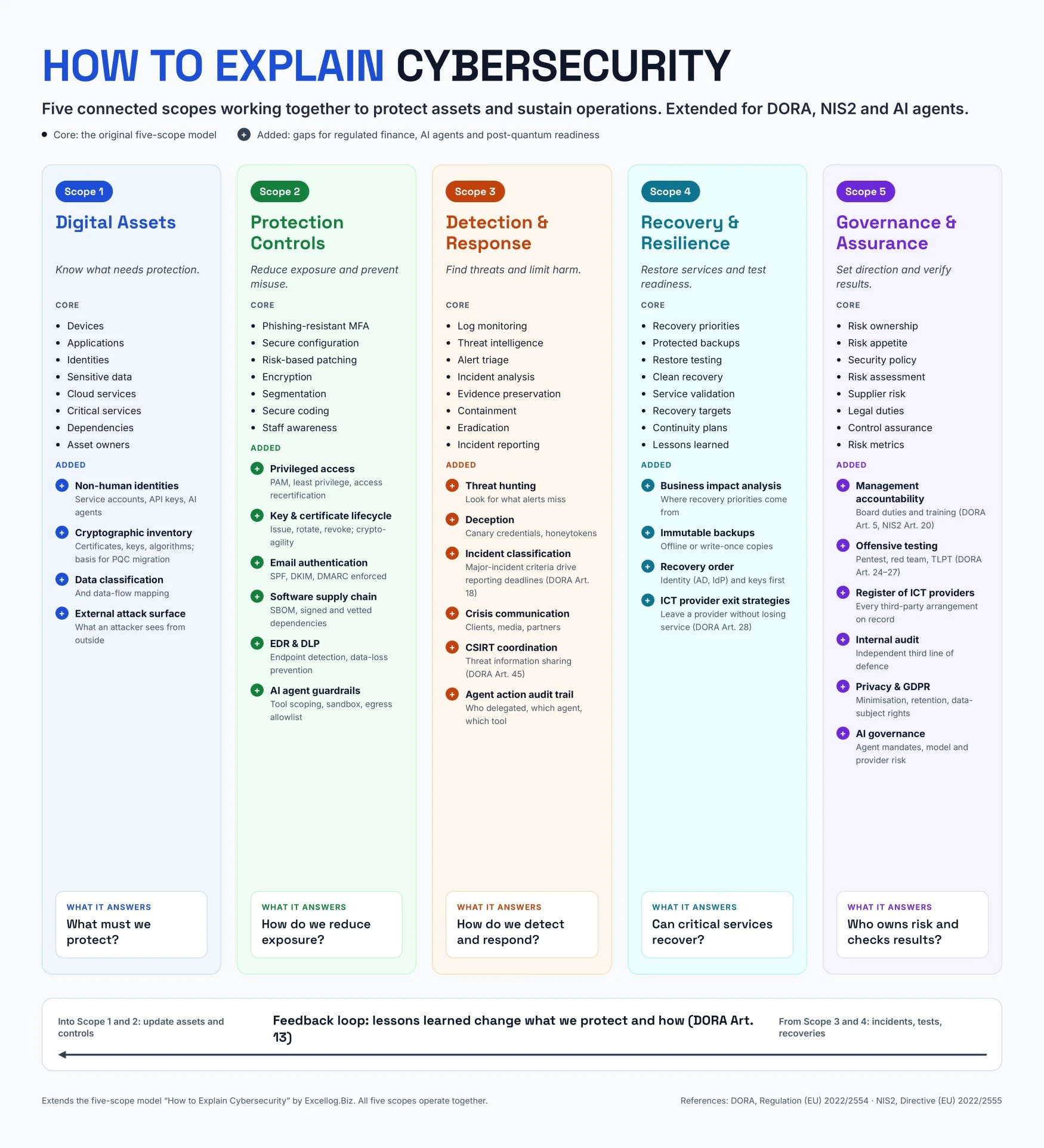
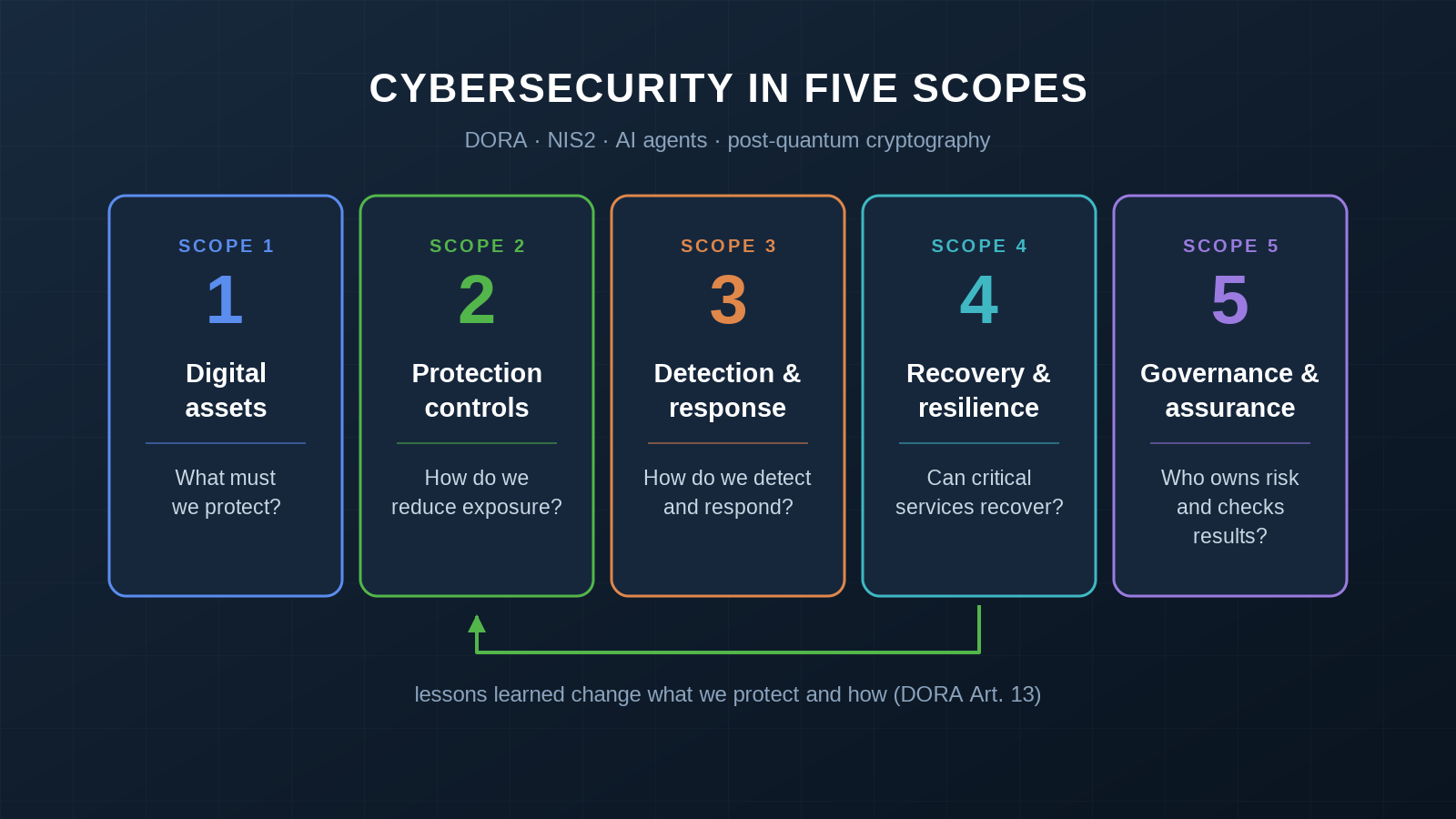
Each scope answers one question. Together, the five questions cover everything management needs to know.
Scope 1. Digital assets: what must we protect?
You cannot protect what you do not know you have.
DORA requires financial entities to identify, classify and document all ICT-supported business functions, the assets that support them and the dependencies between them (Article 8(1)), to map the critical ones (Article 8(4)) and all processes that depend on third-party providers (Article 8(5)).
The core is familiar: devices, applications, identities, sensitive data, cloud services, critical services, dependencies, asset owners. The additions are where inventories usually fall behind:
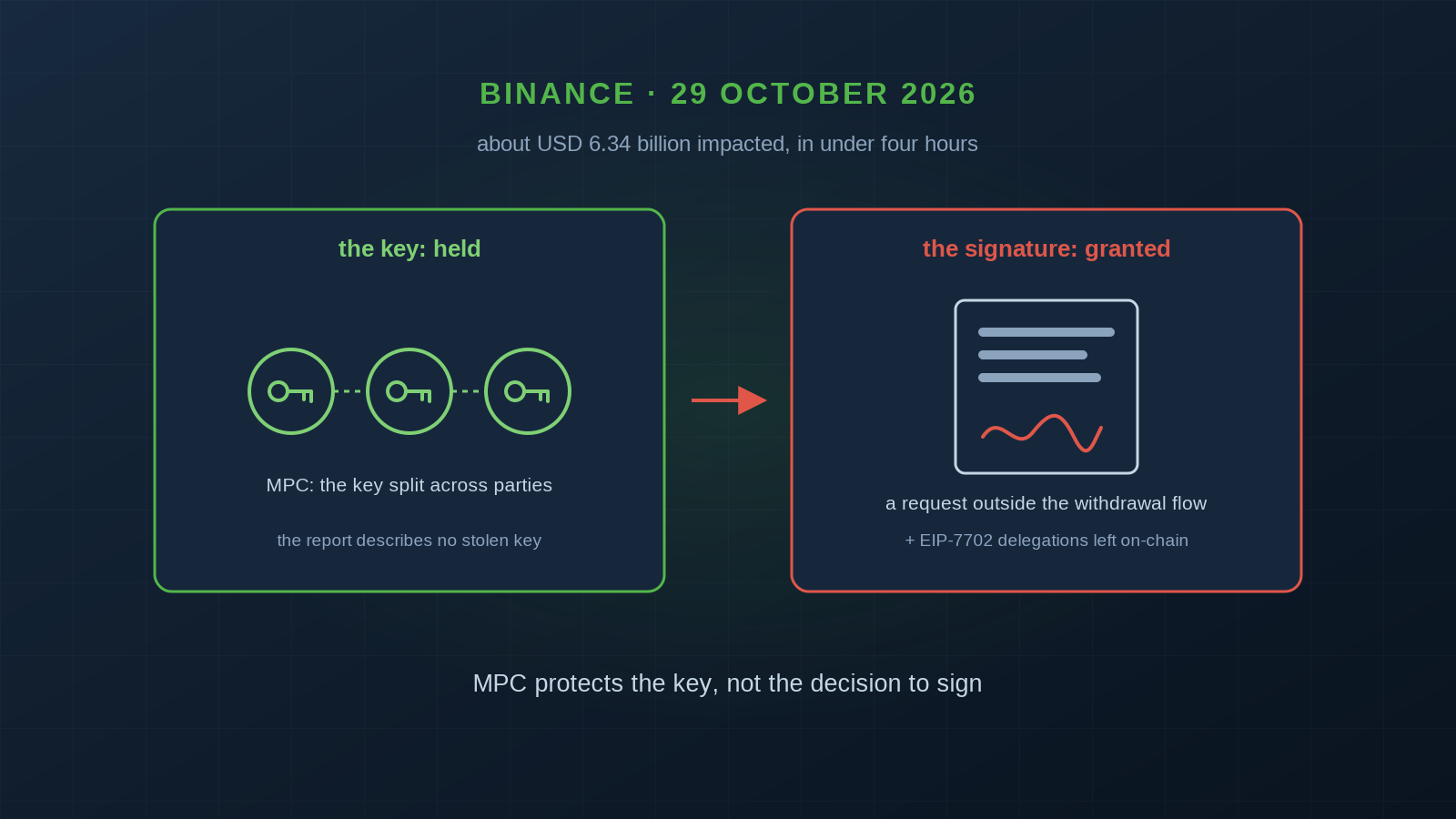
- Non-human identities. Service accounts, API keys, AI agents. In the Binance breach, an internal AI tool served as the bridge between engineers’ machines, and a deployment token sat on a laptop. Neither shows up in an inventory built only from people and devices.
- Cryptographic inventory. Which certificates, keys and algorithms you use, and where. The DORA technical standard requires a register of all certificates and certificate-storing devices, at least for assets supporting critical or important functions (Delegated Regulation (EU) 2024/1774, Article 7(4)). The same register is the starting point for the move to post-quantum cryptography.
- Data classification and data flows. Encryption is decided on the basis of the approved data classification (Article 9(4)(d)). Without a classification, there is nothing to decide on.
- External attack surface. What an attacker sees from outside. It rarely matches what the organisation believes it exposes.
Scope 2. Protection controls: how do we reduce exposure?
Article 9(4) of DORA lists the basics: an information security policy, network management, access limited to what is required, strong authentication, protection of cryptographic keys, change management and a documented patching policy.
NIS2 requires, among other things, multi-factor authentication, cryptography and supply chain security (Article 21(2)(d), (h) and (j)).
The additions:
- Privileged access. Least privilege, emergency and administrator access granted only when needed, regular recertification. The technical standard requires access rights to be reviewed at least once a year, and at least every six months for systems supporting critical or important functions (Delegated Regulation (EU) 2024/1774, Article 21(e)).
- Key and certificate lifecycle. Generation, renewal, storage, revocation, destruction (Article 7(1)), plus renewal of certificates before they expire (Article 7(5)). The encryption policy must also provide for changing the cryptographic technology as cryptanalysis evolves (Article 6(4)). This is where crypto-agility comes in: Member States should start the transition to post-quantum cryptography by the end of 2026, and critical infrastructure should be protected this way by the end of 2030 at the latest, according to the roadmap adopted in June 2025.
- Email authentication. SPF, DKIM and DMARC with an enforced policy, not left in monitoring mode.
- Software supply chain. A component inventory (SBOM), signed and vetted dependencies.
- EDR and DLP. Endpoint detection and data-loss prevention.
- AI agent guardrails. Which tools the agent may call, which sandbox it runs in, where it may send data. An agent that can act on another user’s machine needs the same limits as an administrator account.
Scope 3. Detection and response: how do we detect and respond?
DORA requires mechanisms that promptly detect anomalous activities (Article 10(1)), with multiple layers of control and alert thresholds that trigger the response process (Article 10(2)), plus an incident management process (Article 17).
The additions:
- Threat hunting. Looking for what alerts miss. In the Binance case, the initial report describes no alert during the hours in which the attack was prepared.
- Deception. Canary credentials and tokens that nobody has a legitimate reason to use. Any use is a signal.
- Incident classification. The criteria in Article 18 decide whether an incident is major, and a major incident falls under the reporting obligation in Article 19. Classification must be fast and consistent, because the deadlines depend on it.
- Crisis communication. Clients, media, partners. DORA requires crisis communication plans (Article 14(1)) and at least one person in charge of public communication about incidents (Article 14(3)).
- Threat information sharing. DORA allows financial entities to exchange indicators of compromise, tactics and alerts (Article 45). Entities in scope of NIS2 notify significant incidents to their CSIRT or competent authority (Article 23).
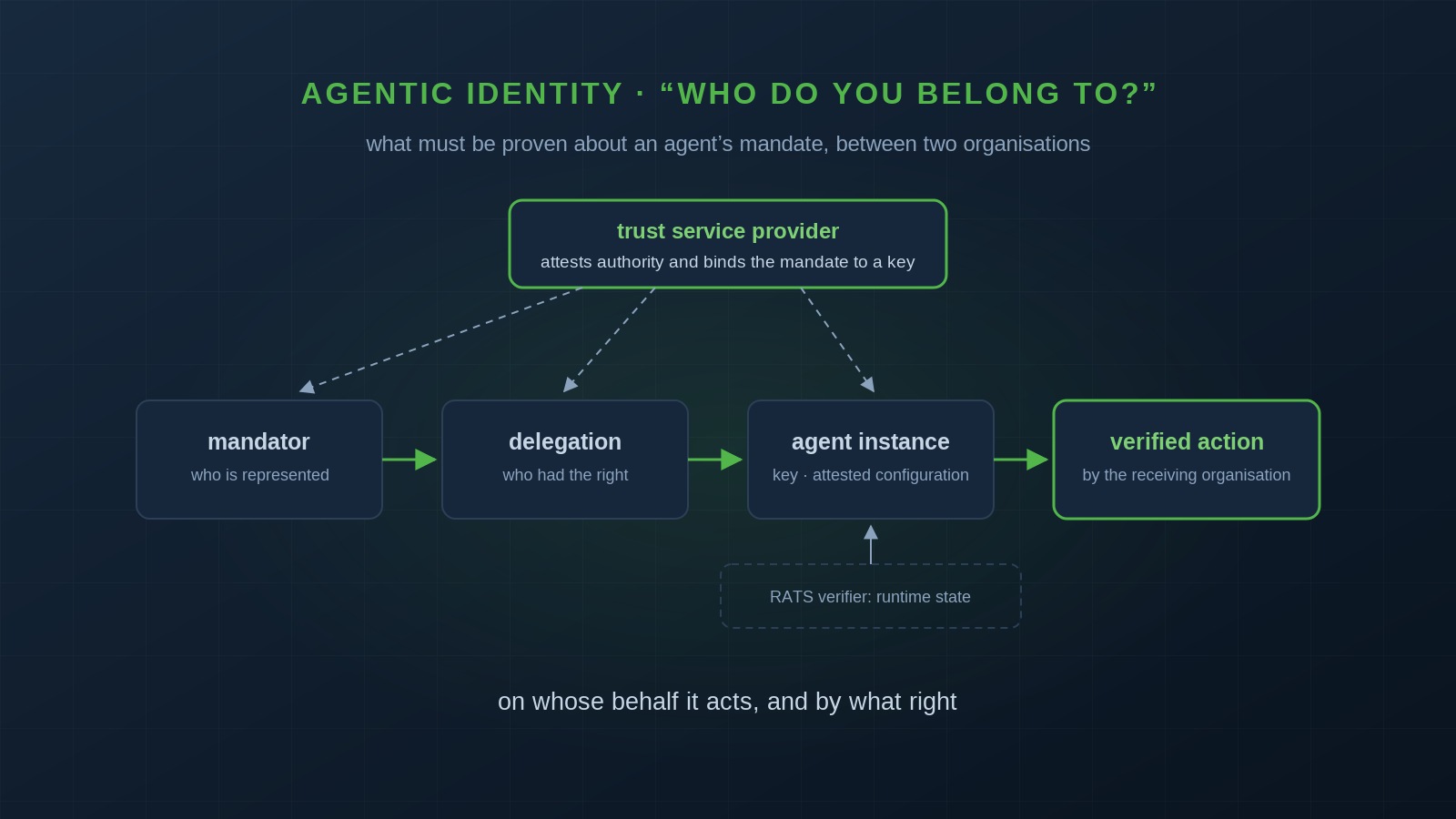
- Agent action audit trail. Who delegated, which agent acted, with which tool. Without the link between an action and the human request behind it, the analysis of an incident involving agents stops at “the agent did it”.
Scope 4. Recovery and resilience: can critical services recover?
DORA requires the response to limit damage and prioritise the resumption of activities (Article 11), with backup policies and restoration procedures (Article 12).
The additions:
- Business impact analysis (BIA). This is where recovery priorities come from, not from the order in which systems were installed. DORA requires it explicitly, as part of the business continuity policy (Article 11(5)).
- Backups the attacker cannot reach. Offline or immutable copies. DORA requires that restoring backup data with own systems uses systems physically and logically segregated from the source system (Article 12(3)).
- Recovery order. Identity first (Active Directory, the identity provider) and keys. A restored server nobody can authenticate to does not bring back any service.
- ICT provider exit strategies. For ICT services supporting critical or important functions, DORA requires exit strategies that also account for a failure of the provider (Article 28(8)).
Scope 5. Governance and assurance: who owns risk and who checks the results?
The core: risk ownership, risk appetite, security policy, risk assessment, supplier risk, legal duties, control assurance, risk metrics.
The additions:
- Management accountability. DORA Article 5 and NIS2 Article 20, quoted above. Training for members of the management body is an obligation, not an option.
- Offensive testing. Resilience tests are carried out by independent parties, internal or external (Article 24(4)). Entities identified by the authority carry out threat-led penetration testing (TLPT) at least every three years (Article 26(1)), with testers who meet the requirements in Article 27.
- Register of ICT providers. All contractual arrangements with ICT third-party service providers, in a register kept up to date and made available to the authority on request (Article 28(3)).
- Internal audit. The ICT risk management framework is audited regularly by independent auditors, and critical findings have a formal follow-up process (Article 6(6) and (7)).
- Privacy. Minimisation, retention, data-subject rights, under the GDPR.
- AI governance. Agent mandates, model risk and model provider risk. An agent that acts on behalf of the organisation needs an approved mandate, just like an employee with signing authority.
The loop: what you learn changes what you protect
The arrow under the five columns is the part most easily forgotten. DORA requires lessons from testing and from real incidents, including problems that came up when continuity plans were activated, to feed into the ICT risk assessment (Article 13(3)). In practice, every incident and every test in scopes 3 and 4 must change something in scopes 1 and 2: a new asset in the inventory, a new control or a stricter one. A post-incident report that changes nothing in the inventory or the controls has not closed the loop.
DORA or NIS2?
The map cites both texts because they overlap. For financial entities, however, DORA is the sector-specific act in relation to NIS2: ICT risk management, major incident reporting, testing and information sharing follow the DORA rules (NIS2 recital 28). A bank builds its map on DORA. NIS2 matters for its suppliers and partners that fall within the scope of the directive.
How to use the map
Ask three questions for each scope:
- Who is accountable? A name, not a department.
- What evidence shows it works? A test report, an up-to-date register, a successful restore, not an approved policy.
- When was it last tested?
A scope with no answer to the third question is an assumption. And the scopes depend on each other: a rehearsed recovery does not help if the inventory in scope 1 left out the identity system, and good detection does not help if nobody in scope 5 decides what happens with the alert.
Sources
- Regulation (EU) 2022/2554 (DORA)
- Directive (EU) 2022/2555 (NIS2)
- Delegated Regulation (EU) 2024/1774: regulatory technical standards on the ICT risk management framework
- European Commission: roadmap for the transition to post-quantum cryptography (23 June 2025)
- Binance: initial report on the 29 October 2026 incident
Frequently asked questions
Why five scopes and not a list of controls?
Because each scope answers one question a board member can ask: what we protect, how we reduce exposure, how we detect and respond, whether critical services can recover and who owns the risk. A list of controls does not show how they connect.
Does NIS2 or DORA apply to a bank?
For financial entities, DORA is the sector-specific act in relation to NIS2 (NIS2 recital 28). ICT risk management, major incident reporting, testing and information sharing follow the DORA rules.
What do AI agents add to the map?
They show up in four of the five scopes: as non-human identities in the inventory, with limits on what they can do in protection, with logs that tie every action to the human request behind it in detection, and with an approved mandate in governance.
Where do I start?
Ask three questions for each scope: who is accountable, what evidence shows it works and when it was last tested. A scope with no answer to the third question is an assumption.