The key was safe. The signature was not: what the Binance breach teaches regulated finance
by Claudiu Hulea · IT Management Consultant
Four hours, USD 6.34 billion
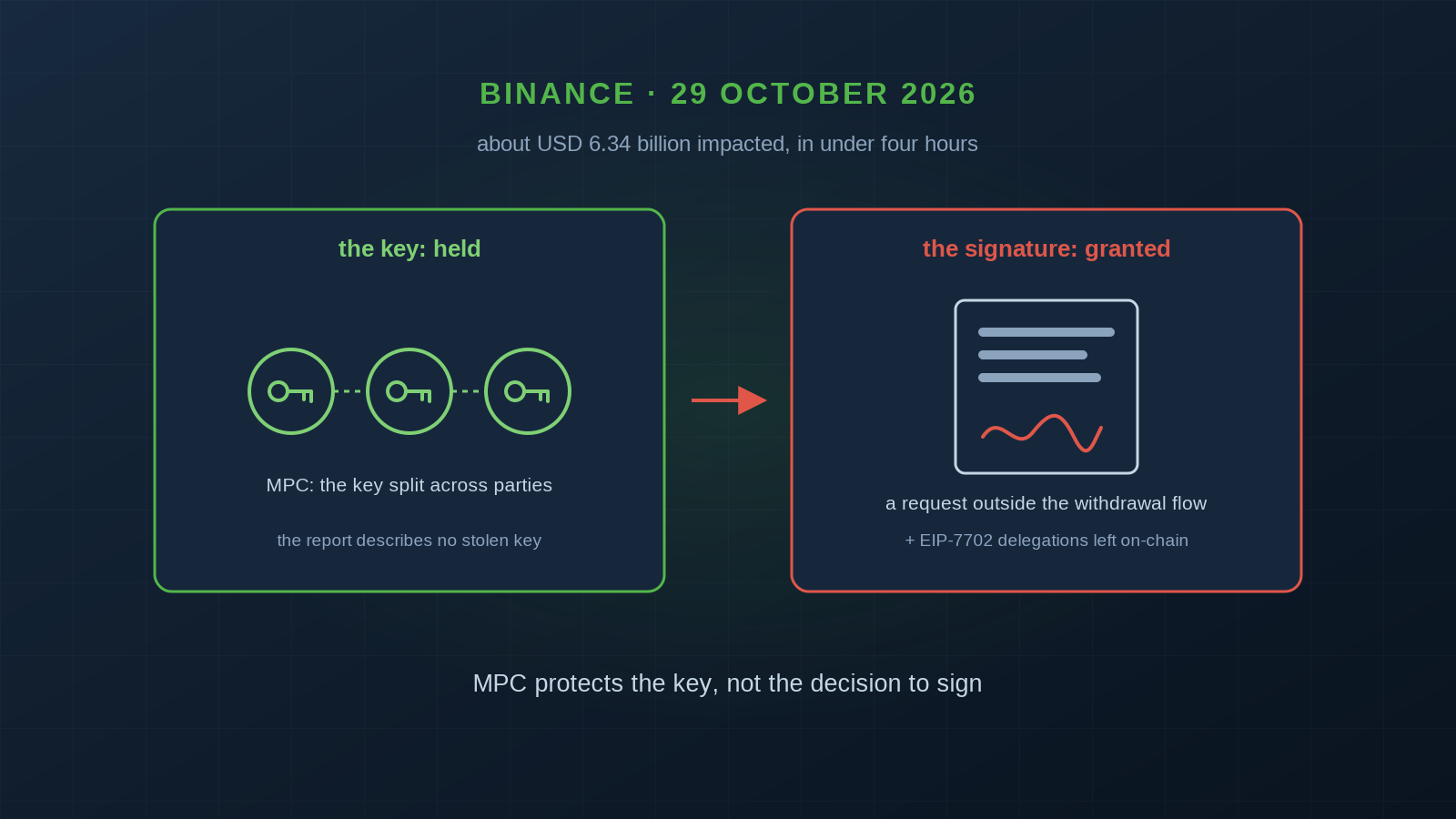
On 29 October 2026, attackers drained Binance hot wallets in under four hours, between the first transfers at 20:05 UTC and the last at 23:56 UTC. Binance puts the impact at about USD 6.34 billion in digital assets. About USD 2.85 billion has since been frozen or intercepted. Binance says it will absorb the loss, and its initial report cites the FBI in attributing the attack to North Korea.
The headline number will dominate the coverage. The lesson for banks lies elsewhere. Binance’s hot wallets used Multi-Party Computation (MPC), and the report describes no stolen key. Nothing in the report suggests the cryptography was broken. What failed was the question every signing system must answer before it signs: should this transaction exist at all?
This article reads Binance’s initial report through the eyes of a regulated financial institution. The facts below come from that report. Where it is silent, I say so.
Not quite a supply chain attack
Binance calls the June starting point a supply chain attack. Nothing in the report suggests Homebrew itself was compromised. An engineer searched for a popular AI coding tool on a search engine and downloaded a tampered Homebrew installation to install it. The SANS diary Binance links describes malicious search ads leading to pages that impersonate Homebrew. If that is what happened here, and Binance does not say, this is malvertising aimed at developers, not a compromised supplier.
The distinction matters because the defence differs. Vendor due diligence does not help here. Only control over what runs on engineers’ machines does.
The campaign ran for five months:
- June: reconnaissance. Engineer A, on the Wallet DevOps team, downloads the tampered installation. Binance detects it, replaces the device and rotates credentials. But the attacker now knows who works on wallet infrastructure. The endpoint was cleaned; the team’s exposure was not.
- September: initial access. Software Engineer B is approached on a legitimate job platform. Two rounds of fake interviews follow. In the first, an “HR representative” shares a social media account full of personal photos to build trust. The final “assignment” is a code repository that runs malicious code during setup, on his work computer.
- Persistence. The malware replaces the
pyenvexecutable installed through Homebrew (/opt/homebrew/Cellar/pyenv/2.8.0/libexec/pyenv) with a version 70 bytes larger (3,344 to 3,414 bytes). In effect, everypyenvcall from then on also runs the attacker’s code. Endpoint protection did not detect what Binance calls 0-day malware. The report does not say whether elevated rights were needed. On Apple Silicon Macs they usually are not, because/opt/homebrewis owned by the user who installed Homebrew. That last point is my observation, not Binance’s. - 20 October: lateral movement. From B’s machine, the attacker uses an internal AI tool to take control of Engineer A’s computer and that of a third engineer, C. A’s computer holds a container deployment token.
- 29 October, 17:15 to 19:56: staging. The attacker logs onto C’s computer, uses A’s credentials, deploys a container and triggers a malicious script that launches the attack on wallet signing operations. The report does not give a time zone for this window, and mentions no alert during it. The first alert it describes concerns the large transfers that followed.
- 20:05 to 23:56 UTC: theft. The report names XRP, SOL, OP, BTC and ETH leaving the hot wallets; TRM Labs counts outflows on ten chains. The malicious on-chain delegation is cleared at 00:10 UTC on 30 October.
Binance says it detected and prevented 57 suspected North Korea-linked cases in 2026 alone: fraudulent job interviews, malware disguised as popular developer tools, compromised packages and browser extensions, fake video conferencing apps, social engineering to steal credentials or plant remote access malware. None of the entry techniques is new. What is new is how patiently they were chained.
The springboard was an internal AI tool
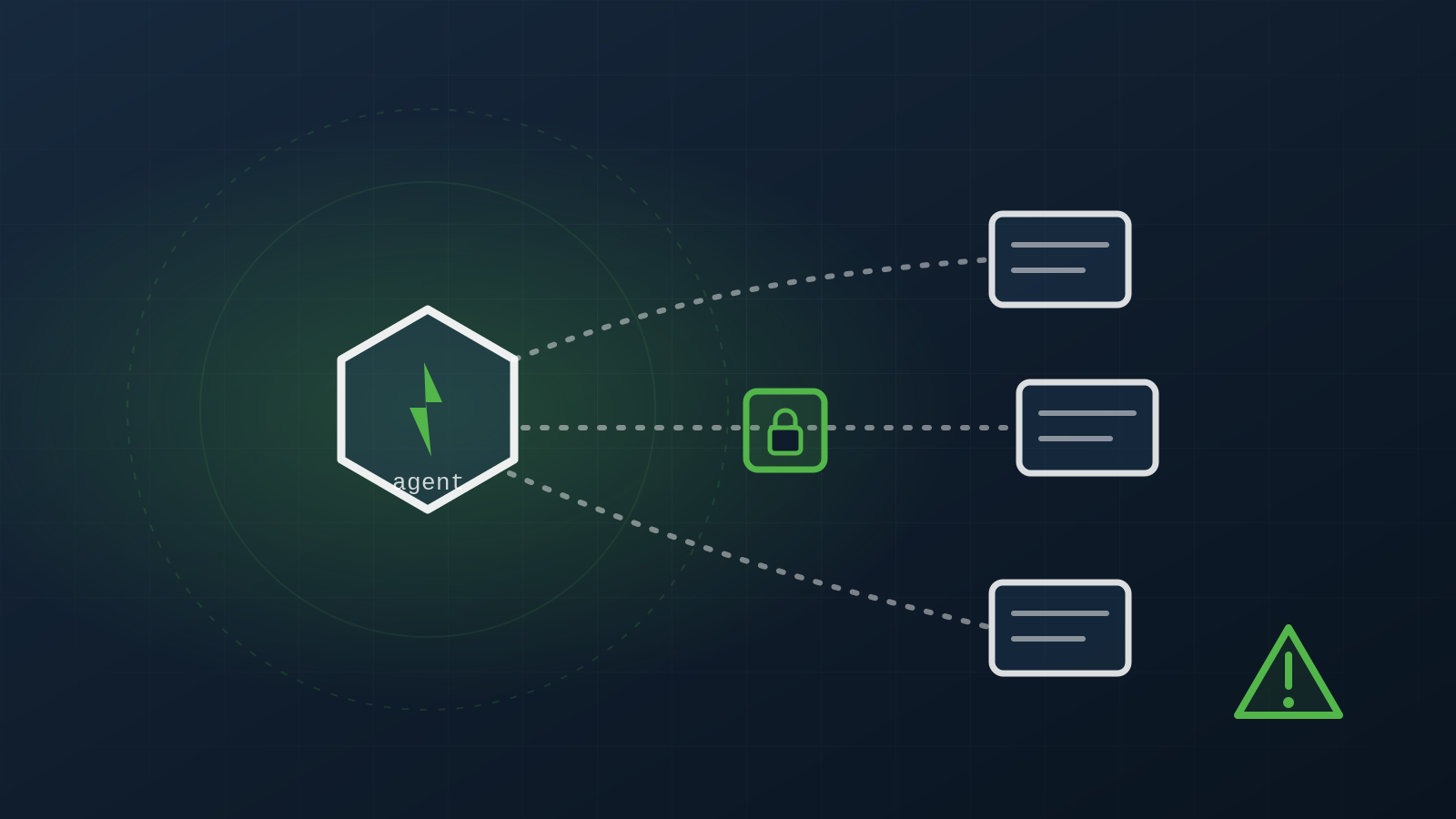
The most important line in the report is also the shortest. On 20 October, the attacker used an internal AI tool to gain control over two other engineers’ machines. Binance does not say how.
The plausible readings are all uncomfortable. The tool could execute actions on colleagues’ computers. Or it held credentials broad enough to reach them. Or it accepted instructions from anyone who could talk to it.
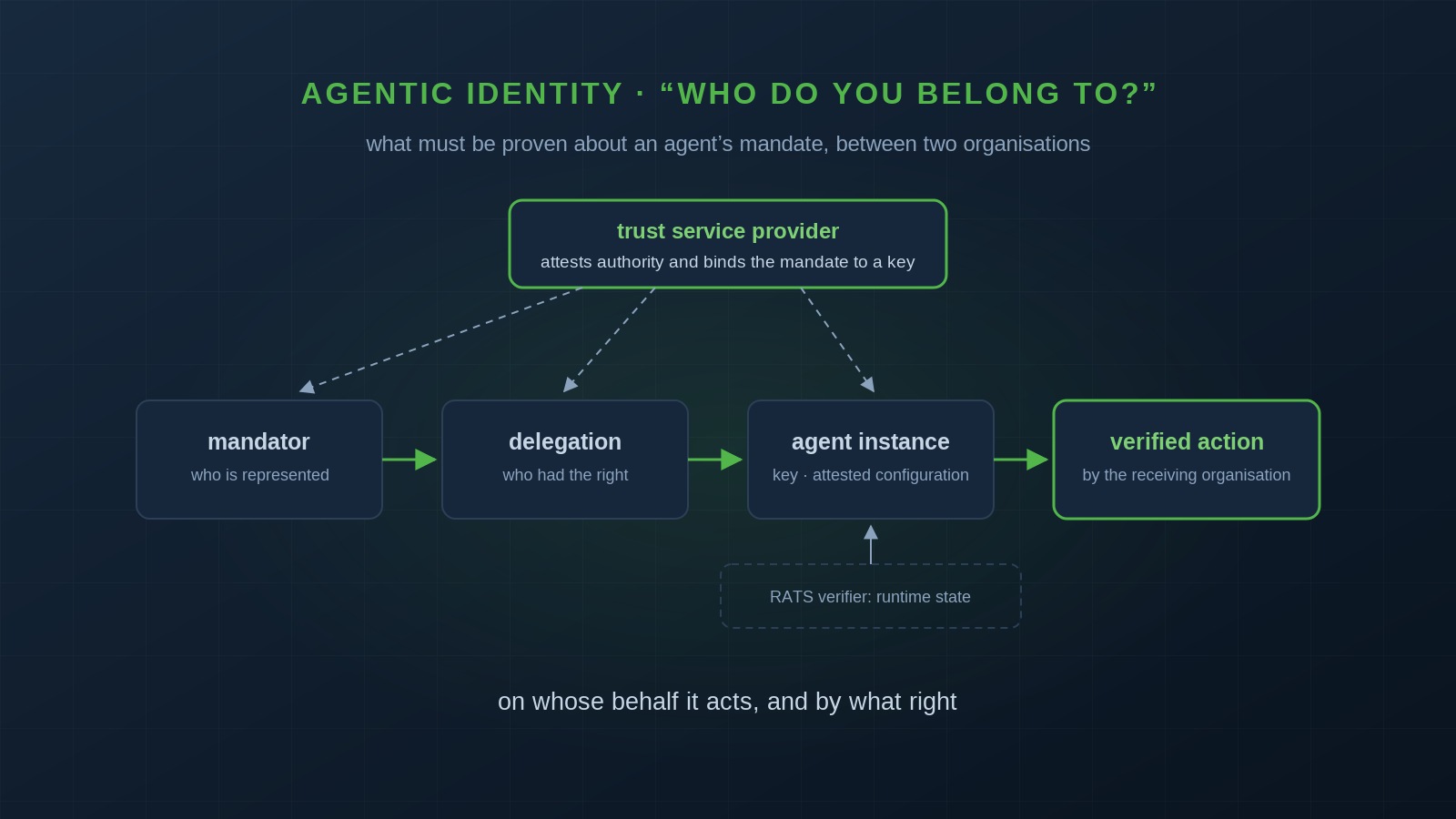
Whichever reading is right, the outcome is the same: the tool could act across user boundaries, and whatever bound its actions to a mandate (who asked, for what, on whose behalf, and for how long) was not enough to stop a compromised colleague.
Classic lateral movement forces an attacker to harvest credentials machine by machine. A well-connected agent removes that step. Compromise one person who can talk to it, and you inherit its reach.
This is the first major public incident I know of in which an internal AI tool is named as the path between engineers’ machines. Earlier cases differ: in the 2025 Salesloft Drift campaign, attackers used compromised OAuth tokens of a third-party chat application to reach customers’ Salesforce data. It will not be the last.
Banks are deploying copilots and agents with access to tickets, code, infrastructure and mailboxes. Under DORA, each one is an ICT asset to inventory (Art. 8), and its access rights fall under the access management rules (Art. 9(4)(c) and the RTS on identity management), like any service account.
In practice, every internal agent needs:
- its own identity, separate from the people who use it;
- an explicit, time-bound mandate stating what it may do and for whom;
- no way to act on another user’s endpoint without that user’s fresh approval;
- logs that tie each action to the human request behind it.
MPC protects keys, not decisions
The attacker never needed a key. They needed the signing service to sign, and it did. Transactions were initiated “outside the normal withdrawal process”, which means the service accepted requests that no approved withdrawal stood behind. MPC split the key across parties. It did not check whether the request made sense.
Two questions follow. Why could a freshly deployed container talk to the signing service at all? And why did the signing policy sign EIP-7702 authorisations, which delegate the wallet itself, on the same footing as a withdrawal?
The second question is where the attack turned. The attacker used the signing service to create EIP-7702 authorisations. That Ethereum mechanism lets an account delegate execution rights to a smart contract. Here, it gave a contract the attacker controlled what Binance calls “partial execution rights” over one hot wallet. The attacker had the signing service sign 50 EIP-7702 authorisations, each for a different nonce, so that at least one would be valid when submitted. Binance describes this as 50 signing transactions “to manipulate the account nonce”; TRM Labs saw the 50 authorisations land in a single transaction at 20:20 UTC.
Once on-chain, those authorisations lived outside Binance’s infrastructure. Suspending withdrawals did not stop them. Shutting down hot wallet services did not invalidate them. And because the wallet used MPC, there was no single key to sign a fast revocation. Binance says it had to develop a dedicated procedure, which took additional time. The last unauthorised transfer finalised at 23:56 UTC, and the delegation was cleared at 00:10.
The lesson travels well beyond crypto. A kill switch that only stops your own systems is not a kill switch when the attacker has already planted authority somewhere else. In banking, the equivalents are standing payment mandates, pre-authorised batches and delegated API tokens at third parties. Each needs a tested way to revoke it, not just to stop issuing new ones.
What banks should check now
Every break in this chain has a counterpart in a bank that signs payments, runs HSMs or operates SWIFT connectivity. The table maps each failure to the control worth testing and the DORA article it falls under.
| Where the chain broke | Control to check | DORA |
|---|---|---|
| An interview “assignment” ran on a work laptop | Work devices run only approved code; external code goes to isolated sandboxes; targeted awareness for staff whose public profiles name the employer | Art. 9, 13 |
| A developer tool was swapped silently | File integrity monitoring on package managers and shims; toolchains not writable by the everyday user | Art. 9, 10 |
| The June compromise was closed as a device problem | When a team is targeted by name, raise monitoring for the whole team, for months | Art. 10, 13 |
| An internal AI tool reached other endpoints | Agents listed in the ICT asset inventory, each with its own identity, scoped mandate and audit trail | Art. 8, 9 |
| A deployment token sat on a laptop | Short-lived, device-bound credentials; just-in-time access to production | Art. 9 |
| The signing service signed out-of-flow requests | An independent policy engine that checks every request against an approved business intent; an allowlist of payload types | Art. 9 |
| On-chain delegations survived the shutdown | An inventory of every standing authority, with a rehearsed revocation procedure | Art. 11, 17 |
| Staging that the report describes without any alert | Detection focused on privileged workstations and on new workloads that call signing services | Art. 10 |
| USD 6.34 billion was reachable from hot wallets | Hard value and velocity limits on anything that can sign without a human | Art. 9 |
One more point for institutions in scope for threat-led penetration testing under Article 26: fake recruitment and an agent-based pivot belong in the threat intelligence that drives the scenarios. A red team that skips them is testing last year’s attacker.
What the independent review must answer
Binance deserves credit for publishing a detailed initial report within five days. Three gaps stand out, and the independent review should close them:
- How did the AI tool grant control? Command execution, a shared credential or prompt injection each call for a different fix.
- Why did the signing service trust a new container? The report does not say whether workloads had to prove their identity, or whether the stolen token was enough to pass that check.
- Why did a deployment token sit on an engineer’s laptop at all, months after the June rotation?
The broader takeaway is simple. For years, the industry has invested in protecting keys: HSMs, MPC, and now post-quantum algorithms. That work matters. But a key is only as safe as the decision to use it. The next generation of controls has to govern authority, meaning who or what may ask for a signature, under which mandate, and how fast that mandate can be withdrawn.
Sources
- Binance: 29 October 2026 Binance Security Incident: Initial Findings and Response Update (3 November 2026)
- SANS ISC: Malicious Ad for Homebrew Leads to MacSync Stealer (1 May 2026)
- CoinDesk: Binance’s $6.3 billion hack began with a fake job interview (3 November 2026)
- Decrypt: Binance finds additional points of breach in $6.3B hack (30 October 2026)
- TRM Labs: North Korea steals USD 6.36 billion from Binance (30 October 2026)
- Google Threat Intelligence: Widespread Data Theft Targets Salesforce Instances via Salesloft Drift (27 August 2025)
- EIP-7702: Set Code for EOAs
Frequently asked questions
Was a Binance private key stolen?
The initial report describes no stolen key. The attacker abused an internal wallet signing service protected by Multi-Party Computation (MPC) and had it sign transactions outside the normal withdrawal process, including EIP-7702 authorisations that delegated execution rights over a hot wallet.
Why did suspending withdrawals not stop the attack immediately?
The EIP-7702 authorisations were already on-chain, outside Binance infrastructure. Suspending withdrawals and shutting down hot wallet services did not invalidate them, and with MPC there was no single key for a fast revocation. Binance cleared the delegation at 00:10 UTC on 30 October with a dedicated procedure.
What role did the internal AI tool play?
According to the report, on 20 October the attacker used a compromised engineer computer and an internal AI tool to gain control over the computers of two other wallet engineers. The report does not say how the tool was abused.
What should a bank check first?
That internal AI agents are inventoried ICT assets with their own identity and a scoped mandate, that signing services check every request against an approved business intent, that every standing authority has a rehearsed revocation procedure, and that anything able to sign without a human has hard value limits.