Non-human traffic has overtaken human traffic. What it means, concretely, for a CISO in financial services
by Claudiu Hulea · IT Management Consultant
Analysis — August 2026
The figure that circulates and the figure that matters
On 6 August 2026, in the Q2 earnings call, Cloudflare CFO Thomas Seifert said that if current trends continue, in five years non-human traffic could be up to 1,000 times greater than human traffic — “humans will be a rounding error on the internet.” The headline went around the press in 48 hours.
It is worth saying from the start what that statement is and is not.
What it is not: a planning figure. It is the answer to an analyst question about monetization, given in a call in which the company reported USD 696.1 million in revenue (+36% year over year) and presented three new products built exactly for this scenario — Monetization Gateway, Wallets and cloudflare.pay. Seifert attached his own calibration label: “with the big caveat that I’ve been wrong at every point along the way.” And he was indeed wrong: in November 2025 he estimated the crossover in the second half of 2027, in March 2026 he had moved it to the first half of 2027, and reality delivered it in May 2026.
Arithmetically, the jump from the current ratio of roughly 1.35:1 to 1,000:1 means a factor of 742 in five years — that is, automated traffic must grow about 3.75 times faster than human traffic, compounded, every year, with no saturation whatsoever. It is an exponential extended linearly into the future, in a market where the same company is simultaneously building the per-request pricing mechanisms that would suppress that volume. The prediction and the product contradict each other.
What it is: confirmation of a structural shift already measured independently, with immediate operational consequences for any institution that exposes digital services. That is where the real subject lies, and it does not need the 1,000x multiplier to be serious.
Three rulers, three numbers, the same direction
First analytical hygiene: there is no “percentage of bots on the internet.” There are several measurements, on different samples, with different definitions.
| Source | Figure | Measured perimeter | Date |
|---|---|---|---|
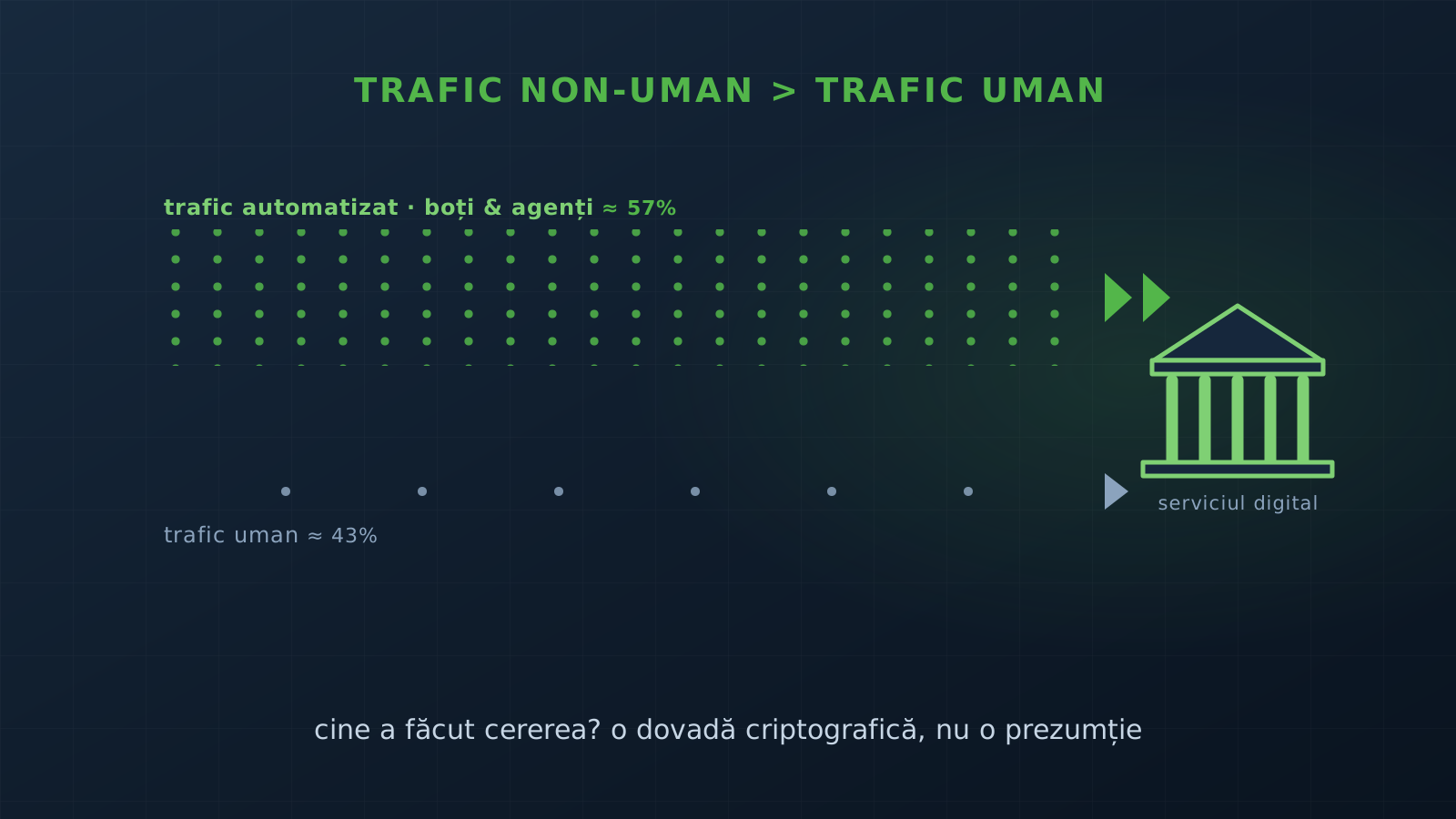
| Cloudflare Radar | 57.4–57.5% automated / 42.5–42.6% human | HTTP requests to HTML content, on the Cloudflare network (~1/5 of the web) | 28 May – 3 June 2026 |
| Imperva / Thales, Bad Bot Report 2026 | 53% automated (up from 51% in 2024) | All web traffic, including application and API calls | April 2026, for the year 2025 |
| Fastly | 49% automated | Requests at the edge; 99% of them classified as “unwanted” | January 2026 |
The three figures do not average and do not substitute for one another. Cloudflare’s excludes video, email and gaming — which is why, measured in bytes, humans remain overwhelmingly dominant: streaming has not gone anywhere. “1,000 times more traffic” in HTTP requests does not mean 1,000 times more traffic in bandwidth.
A second, less comfortable observation: the secondary press has already corrupted the figures. I have seen reports stating the Imperva structure as 40% bad bots + 17.5% good bots = 57.5%, contradicting the 53% in the original report. If a simple percentage degrades across three retransmissions, any figure that lands in a board slide without traceability to the primary source must be treated as unverified.
What all three have in common: the direction. And the direction is enough for decisions.
What changes in the threat model
For financial services, the Imperva 2026 data is more relevant than any five-year projection:
- 24% of all bot attacks targeted financial services — the most affected sector.
- 46% of account-takeover incidents occurred in financial services.
- 27% of bot attacks target APIs directly, bypassing the web interface entirely.
- Bot attacks powered by language models grew 12.5-fold year over year; the daily volume blocked across Imperva’s customer base rose from 2 million to 25 million.
- The seventh consecutive year of growth in the share of malicious bots.
The qualitative change is not the volume, but the disappearance of the behavioural signatures on which two decades of detection relied. A well-built agent runs in a real browser, has a plausible fingerprint, respects human timing, fills in forms with coherent generated text, and solves interactive challenges. The implicit assumption “traffic that looks human = human” has ceased to be a valid assumption.
The consequence for the control architecture: detection based on probabilistic signals becomes insufficient and must be complemented by declared cryptographic identity. Not as a replacement — as an additional layer, for the category of automated traffic that wants to be recognized.
The invisible operational cost
This is the part most analyses miss, because it is not spectacular. Non-human traffic does not cost only security — it costs infrastructure, licensing and analysis time.
| Vector | Mechanism | Typical impact |
|---|---|---|
| WAF / bot management licensing | Many commercial models price per request or per bandwidth at the edge | Growth in automated traffic raises the bill with no business growth |
| SIEM volume | EPS and retention; bot requests generate events like any other | DORA’s 12-month log retention becomes a material cost |
| Origin capacity planning | An agent can generate hundreds-of-thousands of requests per human intent | Sizing by active users becomes invalid |
| False positives | Aggressive bot management blocks real customers | Direct cost in conversion and in support-ticket volume |
| Analytics and reporting | Funnels, conversion rates, marketing attribution | Corrupted business metrics, decisions made on polluted data |
| Fraud detection | Models trained on human behaviour | Rising false-negative rate for ATO |
The practical recommendation, beyond security: move automated traffic into a separate cost and reporting line. If the dashboard has a single “traffic” figure, it already measures nothing useful. The human / verified-bot / unverified-bot / blocked-bot segmentation must be a reporting dimension, not an ad-hoc filter in the CDN console.
The problem that really matters: attribution
When an agent acts on behalf of a customer — checks a balance, compares credit products, initiates a payment — who appears in the log?
Until now, the answer has been a User-Agent string, that is, text anyone can write. This is exactly the problem Web Bot Auth tries to solve, and it is why it deserves far closer attention than any five-year projection.
The mechanism, in brief:
- Cryptographic per-request signatures, based on HTTP Message Signatures (RFC 9421), with Ed25519 keys.
- Three headers on every request:
Signature,Signature-Input,Signature-Agent. Signature-Agentpoints to a JWKS directory published at/.well-known/http-message-signatures-directoryover HTTPS, and the directory response is itself signed, precisely so it cannot be mirrored by someone else.- Short validity periods, explicitly to limit replay attacks.
- A “Signature Agent Card” format — identity, operator, purpose, expected request rate, public keys.
The state of adoption, as of August 2026:
- IETF working group formed in 2026; supporters: Cloudflare, Amazon, Akamai, OpenAI.
- Cloudflare integrated it into the Verified Bots program; the first cohort of “signed agents” includes ChatGPT agent, Goose (Block), Browserbase, Anchor Browser.
- Support implemented in AWS WAF, Amazon Bedrock AgentCore, Vercel, Shopify, Akamai.
- Visa TAP and Mastercard Agent Pay use it as an authentication foundation for agentic commerce.
- In June 2026, New York State passed the Stealth Crawler Prohibition Act, which requires bots to declare their identity and purpose, with penalties of up to USD 15,000 per day per violation.
Translation for a CISO: the agent’s identifier becomes, at once, an audit identity, a billing identity and an access-control identity. You cannot apply a per-agent policy, cannot price a per-agent tier, cannot honour a licensing agreement, and cannot do attribution in an incident while the party’s identifier is arbitrary text.
The regulatory friction, which is real and unresolved
Here financial services has a problem other industries do not.
DORA (in force since 17 January 2025) requires traceability, logging, classification and reporting of ICT incidents, plus the inclusion of third-party providers in the risk perimeter. If an agent operated by a third-party provider accesses the bank’s digital channels on behalf of a customer, that provider enters the third-party ICT-risk discussion — regardless of whether the bank ever signed a contract with it. The register of information has, in its current form, no category for “a provider of agents that my customers use without asking me.”
PSD2 / SCA assumes explicit human authorization for payment orders. There is, in the current framework, no mechanism by which an AI agent would be treated as equivalent to the human payer. PSD3 and the associated Regulation — provisional agreement in November 2025, publication expected in 2026, entry into force 2027 — introduce the concept of delegated payment initiation, but the public text mentions AI almost exclusively in the context of fraud prevention. The gap between what the regulation assumes and what the technology already does is exactly the zone where liability remains unassigned.
AI Act: the obligations for high-risk systems take effect in August 2026, with requirements for risk classification, human oversight, traceability and auditability — applicable including to credit and scoring processes in which agentic components intervene.
NIS2: for in-scope entities, the same incident-management and supply-chain risk requirements, with the same attribution problem.
The governance question, put simply: if tomorrow an agent operated by a third-party provider makes 5,000 authenticated requests on behalf of a customer and one of them produces a disputed transaction, what do you write in the incident report under “actor”?
If the answer is “the IP address and the User-Agent,” you do not have attribution. You have an assumption.
Controls: what to do, in what order
Prioritization by horizon, with the criterion “low implementation cost / real risk reduction.”
0–90 days
| Action | Why |
|---|---|
| Inventory of API exposure, including undocumented endpoints and old versions | 27% of bot attacks target APIs directly |
| Human / verified-bot / unverified-bot segmentation in logging and reporting | Without segmentation, any traffic metric is uninterpretable |
| Enable “verified bots” / “signed agents” verification where the CDN already offers it | Near-zero configuration effort, immediate visibility gain |
| Rate limiting per authenticated identity, not per IP | Residential proxies have made per-IP limiting ineffective |
| Review ATO detection thresholds on the channels with 46% of incidents | Models trained on human behaviour degrade silently |
| Recalculate SIEM and WAF cost on a 24-month automated-traffic projection | Avoids the budget surprise at renewal |
90–180 days
| Action | Why |
|---|---|
| Formal access policy for agents: what is allowed, to whom, at what rate, with what authentication | Precondition for any defensible blocking decision |
| Web Bot Auth validation at the edge and at origin, with fallback to existing detection | Becomes the default as major CDNs adopt it in 2026–2027 |
| Extend the DORA register with agent providers relevant to your own channels | The third-party risk perimeter widened without notice |
| Resilience testing with an agentic-volume scenario, not just classic DDoS | A different load profile: many small, legitimate, authenticated requests |
| Update incident playbooks with an agent-attribution field | A direct DORA traceability requirement |
Strategic (12–24 months)
- An institutional position on agents that act on behalf of customers: prohibited, tolerated, or contractually and technically supported. Neutrality is not a position — it is a decision made by someone else on your behalf.
- Participation in defining consent and liability in agentic flows, before market practice settles without you.
- A structured channel offering for agents (a dedicated, contracted, priced API) that replaces uncontrolled scraping of the public interface. An agent that receives a structured response makes one request, not five hundred. This is, in fact, also the main reservation about the 1,000x scenario.
The falsifiability test
Any thesis that cannot be disproved is not a thesis, it is a position. The indicators to watch through 2028, with thresholds:
| Indicator | Situation in August 2026 | What would confirm the acceleration thesis | What would disprove it |
|---|---|---|---|
| Bot:human ratio, Cloudflare Radar | ~1.35:1 | >4:1 by the end of 2027 | Stagnation below 2:1 |
| Share of signed automated traffic | Small initial cohort | Most commercial agents signed | Adoption stuck below 20% |
| Average price per agent request | Near zero, pilot | A functioning micro-pricing market | Pricing remains an experiment |
| Share of non-human bytes | Marginal versus video | Convergence with the request share | Stays marginal — the most likely case |
| ATO attacks in financial services | 46% of incidents | Sustained growth | A plateau after agent detection matures |
The 1,000x prediction is unfalsifiable until 2031, which makes it operationally useless. The indicators above are verifiable quarterly.
Conclusion
The statement that generated the headlines is an artefact of financial communication: real as a quote, explicitly conditioned by its author, measured on a narrow ruler, and issued by a company that sells both the problem and the solution.
The shift underneath, however, is real, measured by three independent providers, and has consequences that do not depend on the multiplier: financial services is the most targeted victim of hostile automated traffic, APIs are the primary attack surface, and the identity of the party making the request has ceased to be deducible from behaviour.
The architecture decision that matters in the next 18 months is not whether humans will become a rounding error. It is whether the institution can answer, in an incident report, the question “who made the request” — with cryptographic proof, not a presumption.
Sources
- The Register — “Humans will be a rounding error on the internet” says Cloudflare exec (7 August 2026)
- Cloudflare Q2 FY2026 earnings call transcript (6 August 2026)
- Cloudflare Radar — Bot Traffic Worldwide
- Imperva / Thales — Bad Bot Report 2026: Bots in the Agentic Age (29 April 2026)
- NBC News — Bot web traffic has overtaken human web traffic, data shows (5 June 2026)
- Cloudflare Blog — Message Signatures are now part of our Verified Bots Program
- Cloudflare Blog — The age of agents: cryptographically recognizing agent traffic
- IETF — Registry and Signature Agent card for Web Bot Auth, draft-meunier-webbotauth-registry-01
- AWS — Reducing CAPTCHAs with Web Bot Auth, Bedrock AgentCore
- Osborne Clarke — Agentic Payments: a new challenge for Europe’s payments ecosystem (March 2026)
- Taylor Wessing — Agentic AI in payments: key regulatory considerations (February 2026)
- Regulation (EU) 2022/2554 (DORA), in force since 17 January 2025
Frequently asked questions
Has automated traffic really overtaken human traffic?
Yes, in HTTP requests — measured independently by three providers in 2026: Cloudflare Radar ~57% automated, Imperva/Thales 53%, Fastly 49%. An important nuance: this is HTTP requests, not bandwidth (bytes) — measured in bytes, humans remain dominant because video streaming has not gone anywhere. The three figures do not average (different perimeters), but the direction is the same.
What is Web Bot Auth and why does it matter?
A cryptographic identity mechanism for automated traffic: per-request signatures based on HTTP Message Signatures (RFC 9421), with Ed25519 keys and the Signature / Signature-Input / Signature-Agent headers. It solves attribution — it replaces the User-Agent string (arbitrary text) with a verifiable proof. Already adopted by Cloudflare, AWS, Vercel, Shopify, Akamai, and used by Visa TAP and Mastercard Agent Pay.
Why is financial services the most exposed sector?
According to the Bad Bot Report 2026 (Imperva/Thales): 24% of bot attacks target financial services (the most affected sector), 46% of account-takeover incidents occur in financial services, and 27% of bot attacks target APIs directly, bypassing the web interface. Plus the compliance friction (DORA, PSD2/SCA, AI Act, NIS2) that other industries do not have.
Is the "1,000x" figure real?
Not as an operational prediction. It is the Cloudflare CFO's answer to an analyst question about monetization, explicitly hedged by its author ("with the big caveat that I've been wrong at every point"), issued by a company that sells both the problem and the solution. It is unfalsifiable until 2031, hence operationally useless. The measured shift underneath, however, is real and does not depend on the multiplier.